
Ion exchange chromatography (IEC) is an essential technique in the separation of charged biomolecules Ion Chromatography. It operates on the principle of electrostatic interactions between analytes and resin sites. By adjusting pH and ionic strength, this method achieves distinct retention times for various species. Such precision is crucial in isolating target compounds from impurities. Understanding the mechanisms and advantages of IEC reveals its significance in diverse applications, prompting further exploration into its evolving methodologies.

The Fundamentals of Ion Exchange Chromatography
Ion exchange chromatography (IEC) serves as a pivotal technique in the separation and purification of biomolecules, particularly proteins and nucleic acids.
The fundamental ion exchange principles rely on the interaction between charged biomolecules and stationary phase resins, which are either cationic or anionic in nature.
These separation techniques exploit differences in the net charge of biomolecules under specific pH conditions, enabling selective binding to the resin https://laballiance.com.my/. As the sample passes through the column, components with varying charge densities are retained or eluted based on their affinity for the resin.
This method not only enhances the resolution of complex mixtures but also provides a robust framework for further purification steps, establishing IEC as an essential tool in biochemical analysis and research applications.
Mechanisms of Separation in IEC
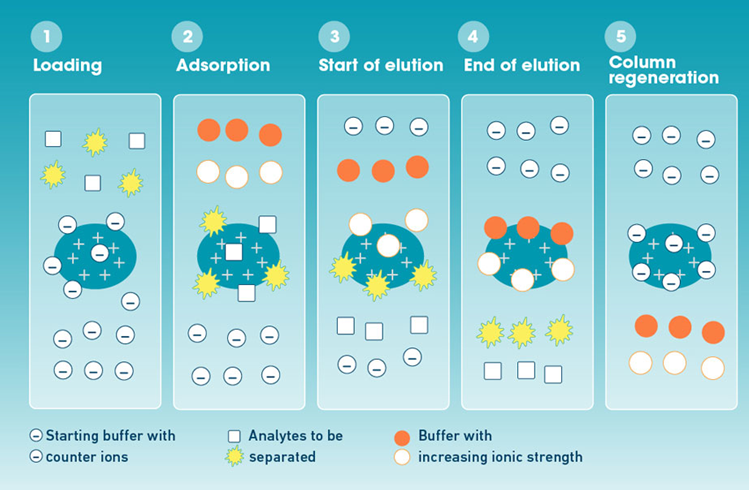
Separation mechanisms in ion exchange chromatography (IEC) are fundamentally driven by the electrostatic interactions between charged biomolecules and the functional groups on the stationary phase resin.
The process involves the reversible exchange of ions between the mobile phase and the stationary phase, where positively or negatively charged analytes are attracted to oppositely charged sites on the resin. High-resolution separation is achieved as different biomolecules interact variably based on their charge density and distribution.
This differential binding leads to distinct retention times, allowing for effective separation. Additionally, factors such as pH, ionic strength, and temperature can influence ion exchange dynamics, further enhancing the specificity and accuracy of the separation mechanisms employed in IEC.
Advantages of Ion Exchange Chromatography
While many chromatographic techniques offer unique benefits, ion exchange chromatography (IEC) stands out due to its exceptional specificity and versatility in separating charged biomolecules.
One primary advantage of IEC is its significant selectivity improvement, allowing for the effective separation of closely related species based on their charge differences. This specificity is essential for the purification of complex samples, including proteins and nucleic acids, where even minor variations can impact biological function and application.
Additionally, IEC facilitates high-resolution separations, enabling the isolation of target molecules from contaminants efficiently. The ability to manipulate pH and ionic strength further enhances the technique’s adaptability, making it a preferred choice for researchers aiming for high-quality sample purification in various analytical and preparative contexts.
Applications Across Different Fields
Although ion exchange chromatography is often associated with biochemistry and molecular biology, its applications extend across various fields, including pharmaceuticals, environmental science, and food technology.
In biopharmaceutical production, this technique is essential for purifying proteins and monoclonal antibodies, ensuring product efficacy and safety. The high resolution and selectivity of ion exchange chromatography facilitate the removal of impurities, which is critical in compliance with regulatory standards.
In environmental monitoring, it serves as an important tool for detecting and quantifying ions in water and soil samples, aiding in pollution assessment and management. The ability to isolate specific ions enhances the accuracy of assessments, supporting informed decision-making in environmental protection and remediation strategies.
Future Innovations in Ion Exchange Techniques
Innovations in ion exchange techniques are anticipated to enhance the efficiency and versatility of this chromatography method across diverse applications.
Future developments are likely to focus on the integration of novel materials, such as advanced resins and membranes, which can improve selectivity and binding capacity. These materials may enable greater resolution and faster separation times, addressing the increasing demands of various analytical processes.
Additionally, automation advancements are expected to streamline operations, reducing human error and increasing throughput. Automated systems could facilitate real-time monitoring and adaptive control of ion exchange processes, allowing for optimized conditions based on sample characteristics.
Collectively, these innovations promise to greatly elevate the precision and applicability of ion exchange chromatography in laboratory and industrial settings.
Conclusion
To sum up, ion exchange chromatography stands out as a pivotal technique for achieving high separation accuracy through its reliance on electrostatic interactions. By manipulating pH and ionic strength, this method allows for tailored binding, resulting in distinct retention times for various biomolecules. Its advantages, including high specificity and resolution, make it indispensable across diverse applications, from biopharmaceutical production to environmental monitoring. Future innovations promise to enhance its efficacy further, solidifying its role in advanced analytical separation techniques.